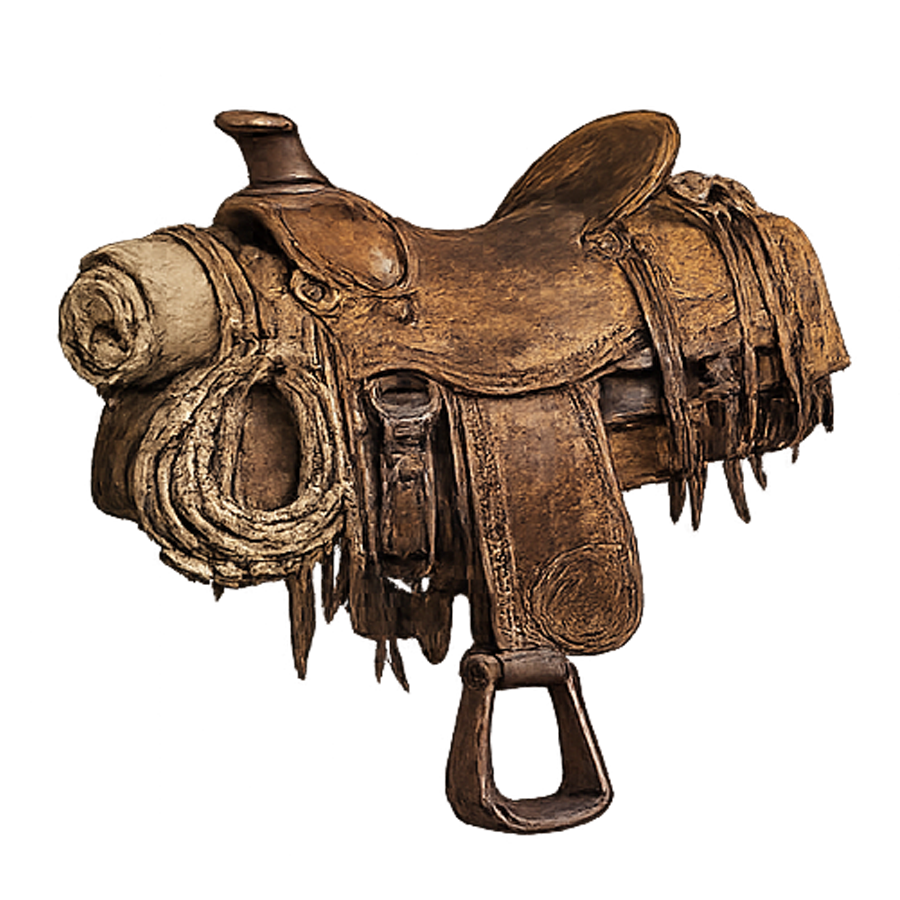
The Frazier shop in Pueblo produced working saddles of consistent construction throughout the latter decades of the nineteenth century. This example, catalogued as PS-01, dates to 1889 and bears the shop's characteristic radial arc pattern on the skirt — three repeating arcs, stamped with an even hand. The tree is rawhide-wrapped, the build heavy by design. It was made for use, not ornament, and the condition of the leather across its documented working life supports that purpose. The Frazier mark is present on the underside of the fender, partially worn but legible to examination.
The saddle passed through four or more documented owners over the course of two decades following its manufacture. A rancher in the Pueblo region acquired it in the early 1890s and worked it for several years before selling. The subsequent buyer held it through the late 1890s and into the early 1900s. These transfers are consistent with the ordinary commerce of working equipment in the region — recorded in bills of sale, noted in estate inventories, or referenced in letters that survive in county and private collections. The chain is unremarkable until its final recorded sale, which occurred in 1910 and is documented in the Bent County transfer ledger.
In 1911, the saddle reappeared in the barn of the man who had sold it the previous year. He had not repurchased it. No record of transport, no bill of return, no letter of explanation has been located in the county ledgers, in the records of any intervening party, or among the papers of the man himself. The saddle was simply present where it had not been, and the man — by his own account and the account of at least one neighbor — had not arranged for its return. Whether he made inquiry into how it came to be there, and to whom, is not known. What is known is that he kept it.
He was found beside the saddle on the morning of March 4, 1912. The cause of death was recorded as natural. The saddle was entered into the archive following an inquiry that produced no further transfers, no heirs claiming the item, and no record of its disposal. The classified notice printed in this paper's archive — placed by a seller who wished the transaction concluded promptly — predates the return. Whether it describes the same transaction as the 1910 Bent County entry, or an earlier one, has not been determined to the archive's satisfaction.