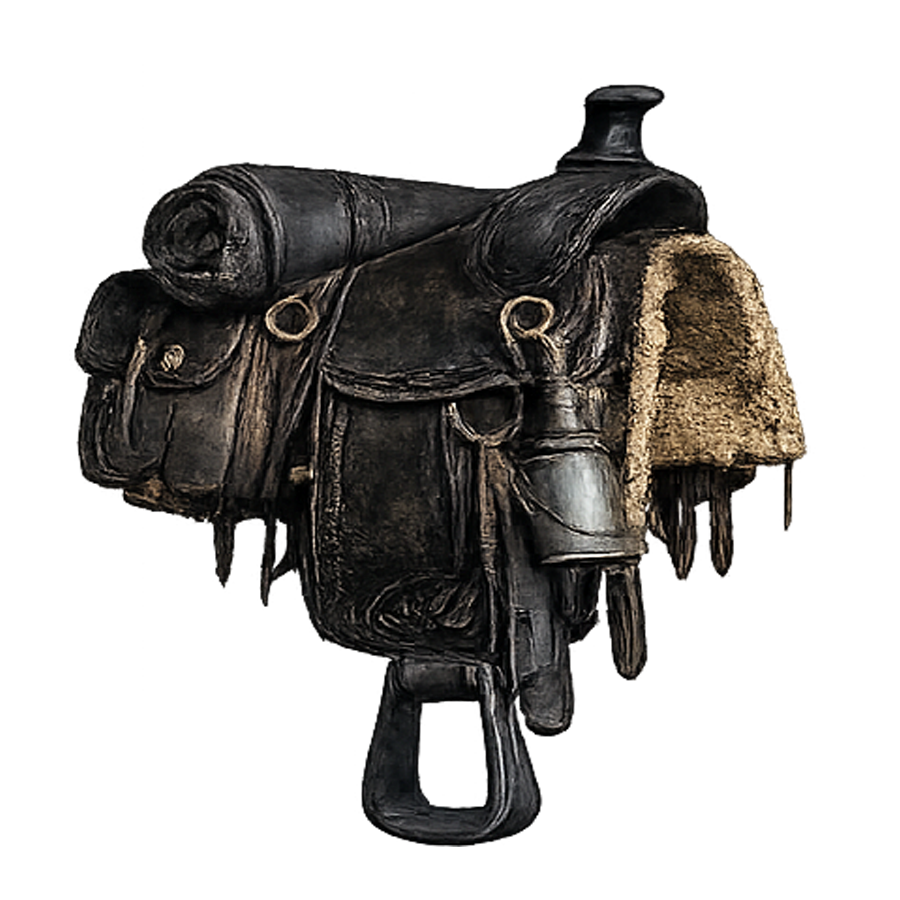
The saddle designated PS-02 in this ledger carries no maker's stamp. It originates in the Trinidad region of southern Colorado and has been dated by construction and material to approximately 1882, though the absence of identifying marks makes a precise date impossible to establish. The leather is black — dyed, not simply darkened by use — and the horn cap is silver, a choice that distinguishes the piece from purely utilitarian work of the period. The build is trail-weight, suited to long distance over varied terrain. Whoever made it knew the country the saddle was intended for.
Two cuts mark the left fender. They are parallel, evenly spaced, and placed on the outward-facing surface where they would be visible to anyone looking at the saddle from the near side. They are not tool marks and not the product of wear. The cuts are clean, deliberate, made with a narrow blade drawn with care. They are not decorative in any recognizable tradition this archive has been able to identify, and they are not positioned in a way that serves a structural purpose. They were put there to be seen. What they were meant to communicate, and to whom, is not recorded anywhere the archive has searched.
The saddle was reported lost in 1899 by its owner at that time, whose identity is known to the archive but whose account of the loss contains no detail useful to reconstruction. In 1901 it was found in a stock dealer's back room in the Trinidad area. The dealer had no clear account of how it arrived there. His records for the intervening period are incomplete, and no bill of sale, consignment note, or transfer document connecting the saddle to the 1899 loss has been located. It changed hands again following its recovery, and its whereabouts after that transaction are not confirmed.
A first-person account filed with this archive describes the saddle as it existed in 1894, five years before the reported loss. A rider who acquired it that year wrote, some decades later, that the saddle had seemed already fitted to him in a way he could not account for by break-in or adjustment. He described the two marks at length and stated plainly that he was not able to convince himself they were purely decorative. He held the saddle for a considerable period — his account is dated 1921, and he still possessed it then, or believed he did. What became of it after that date the archive cannot say.