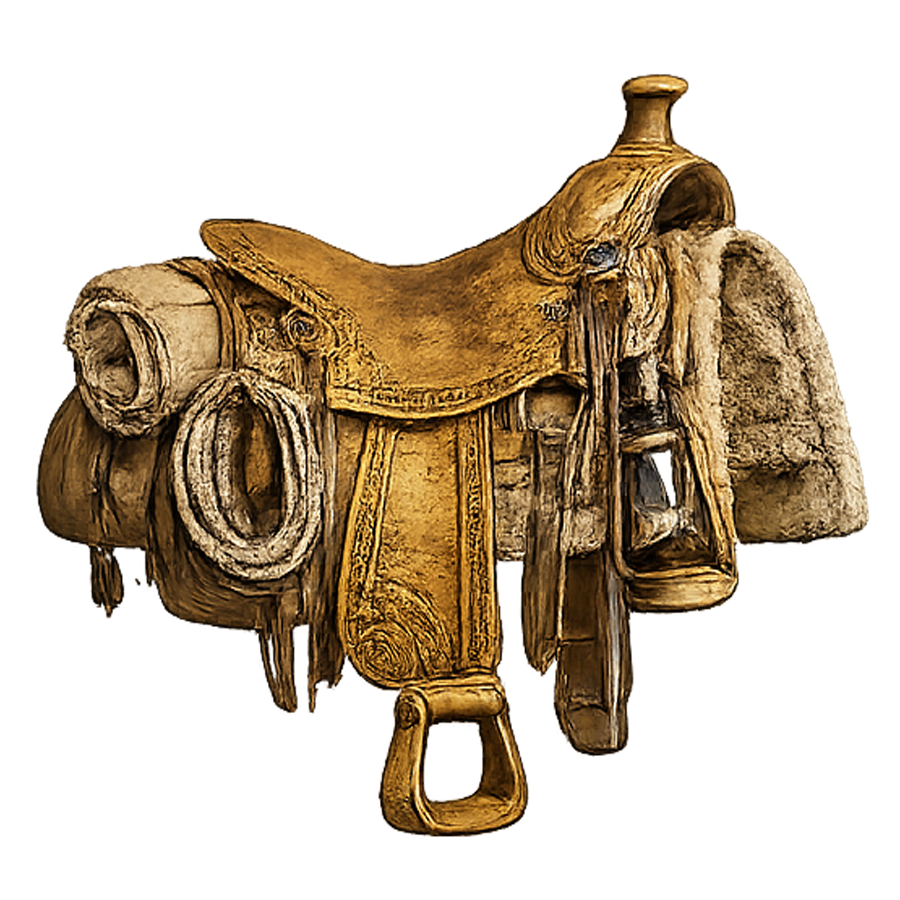
The maker's stamp on the right skirt reads "R.T." — two letters, partially struck, the second deeper than the first, as though the tool was pressed with less certainty on the return. No further mark appears on the saddle. The identification of those initials as belonging to Reuben Tait, land surveyor of the Pueblo region, rests on circumstantial evidence: Tait is documented as having worked leather in addition to his surveying practice, his initials correspond, and no other craftsman of the period working in this region has been identified with those initials. None of this is conclusive. Tait himself never made a written claim to the saddle's manufacture, and no bill of sale has been located.
The tooling on the cantle consists of a double arc pattern — two concentric curves running parallel along the upper rear edge, each line clean and uninterrupted. This is not ornamental work in the common sense. The double arc is a craftsman's signature applied with economy: it does not decorate the surface so much as mark it. A surveyor who also worked leather would understand the difference between a flourish and a notation. The double arc reads as the latter. Its precision is consistent with work done by someone accustomed to recording lines, not embellishing them.
The condition of the saddle is what complicates the record. After what should have been more than a decade of active use in the Pueblo region, the leather shows minimal wear. The tree is sound. The rigging shows no significant stress. The stirrup leathers retain their original suppleness. Either the saddle was rarely put to working use — kept rather than ridden — or it changed hands infrequently and was stored with care between owners. The archive has not located a chain of custody that would explain the condition. It arrived in the record as it stands: near-new, origin uncertain, initials stamped but not explained.
Reuben Tait died in 1908. He did not leave a will that has been located, and no inventory of his personal effects itemizing a saddle has been found in the county records. The question of whether "R.T." marks the saddle as his creation or his property was not resolved before his death and has not been resolved since. The two possibilities carry different implications. If he made it, the near-new condition suggests it was never sold into working use and remained with him or in storage. If he owned it rather than made it, the maker is unknown and the stamp is unexplained. The archive records both possibilities without resolving them.