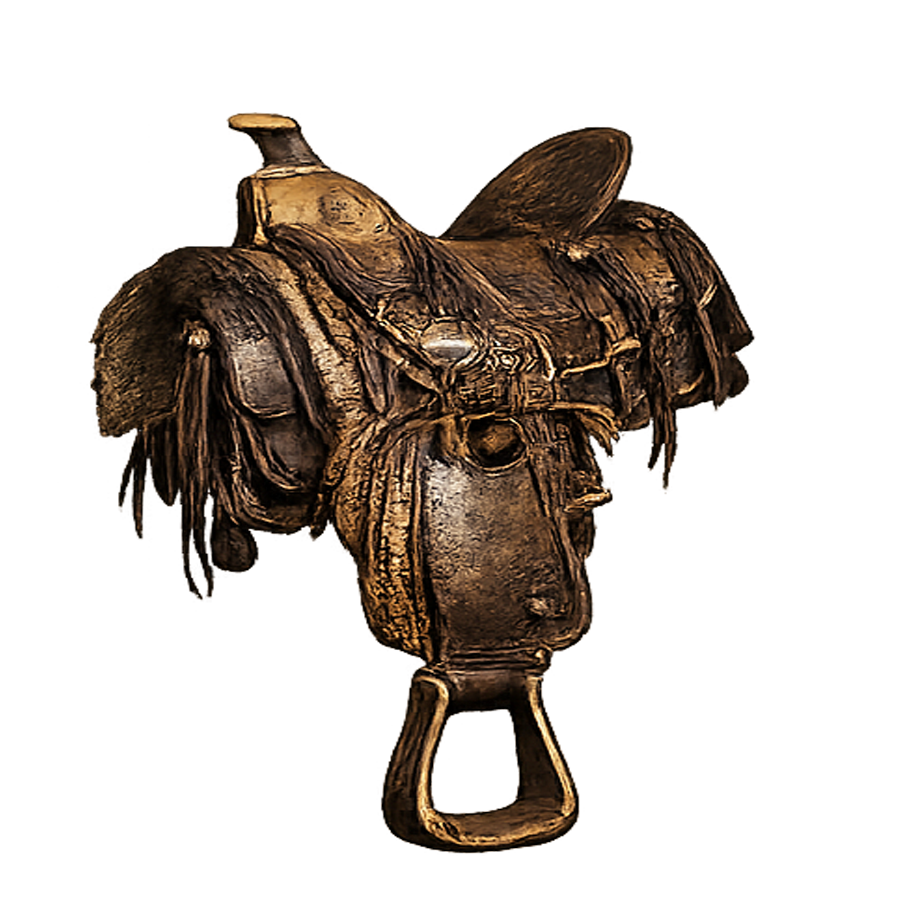
Gideon Pruett operated as a saddler in Trinidad, Colorado, from approximately 1882 through the late 1890s. His work is documented in several sale and commission records from that period, and the quality of his finished pieces — those that were finished — is described consistently as competent and reliable. He was not an ornamental craftsman by inclination; his tooling was purposeful, his leather selection practical. The saddles he completed are recorded without incident in the ledger of Trinidad tradesmen. He had a body of work. He knew what he was doing.
The saddle catalogued as PS-04 was begun around 1888. The tooling on the skirt proceeds with full precision — each line clean, each arc properly spaced, the pattern coherent and intentional from the first stroke. It runs three-quarters of the way around the skirt and then stops. The stopping point is not ragged. It is not the edge of a tool that slipped or a line that wandered. The work simply ends at a clean boundary, as though Pruett set down his tools at a specific moment and did not pick them up again. The bare quarter of the skirt is smooth leather, untouched, still waiting.
Pruett was asked about the saddle. The record does not specify when or by whom, but the response was preserved: he could not explain why he had stopped. Not that he refused to explain, or that he considered the question impertinent, but that he genuinely could not account for it. He had no memory of a decision. He could not reconstruct a reason. For a craftsman of documented competence — a man who worked leather deliberately and without apparent uncertainty — this absence of explanation was itself noted as unusual by whoever recorded it. He was not the sort of man to leave work unfinished without a reason, and he did not have one to give.
The saddle was never put into service. Pruett did not sell it, did not complete it, and did not speak of it further before his death. It passed into the record as he left it: three-quarters finished, the bare quarter neither flaw nor intention but simply the place where the work stopped. A wanted notice was later placed by parties seeking information on its whereabouts, which suggests the saddle circulated after Pruett's death without a clear owner. The bare quarter of the skirt is now the most documented feature of the object — not because it is the most significant, but because it is the only part that requires explanation.