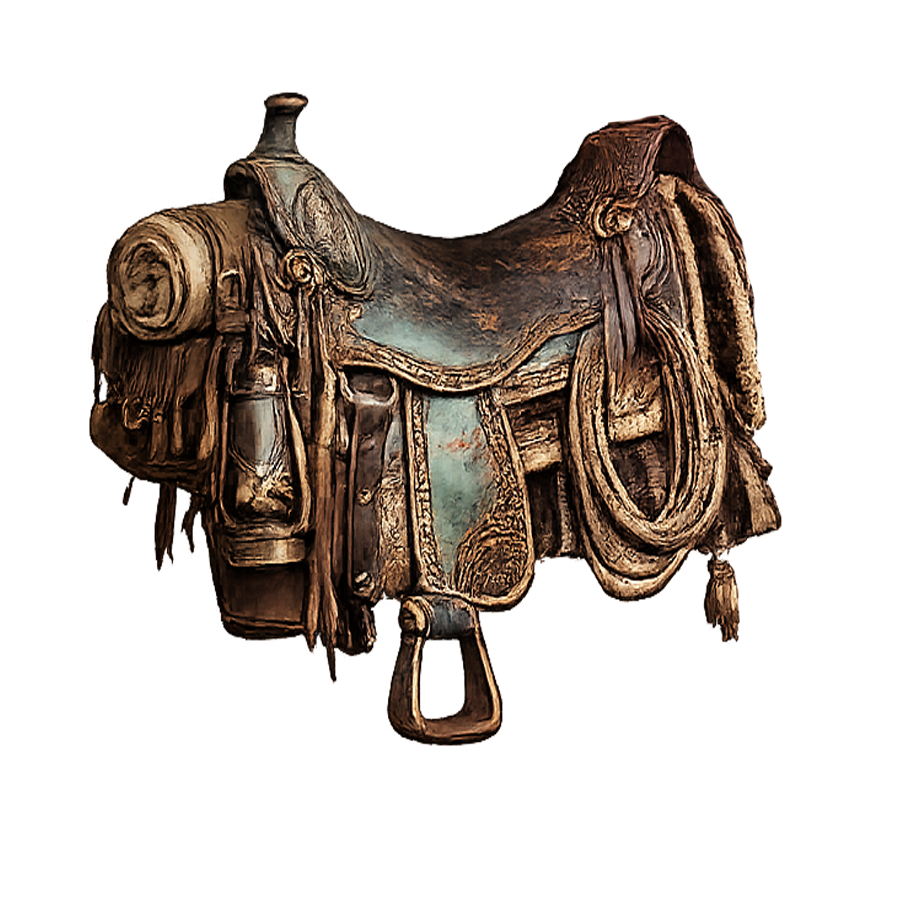
The work on this saddle is total. Arc tooling covers every surface — skirt, fender, cantle, seat jockey, and rigging dee housing — applied with consistency and care that the shop ledger entry cannot explain in terms of a standard commission. A commission of ordinary scope would not require this. A commission of extraordinary scope would have a client named in the record. This one does not. The tooling is present on every surface that could receive it. The record of who asked for it is not present at all.
The apprentice who did the work left no name. There is no record of his arrival at the Pueblo shop, no entry that accounts for when he began or under what arrangement. The shop owner, when later asked to identify him, could not. The apprentice completed the saddle, set it down, and departed without collecting payment and without leaving identification by which he might be located or credited. What remains is the object itself, which is complete, and the record of its making, which is not.
Three owners held the saddle after it left the shop. The transfer records are on file for 1893, 1895, and 1898 — each coming within two years of the previous. The classified notice filed by one of the three owners noted the extensive tooling as the saddle's primary feature; it was the thing most visible and most difficult to account for. None of the three owners offered a reason for releasing it. The transfers are documented. The explanations are absent, or were never given.
The 1:1 classification assigned to this object by the ledger indicates a singular thing — not one of a type, but one of itself. The record reflects this designation at every point: one maker, unnamed; one commission, unclaimed; three owners, none of whom kept it. After 1898 the trail ends. The archive has not located a fourth owner. Whether the saddle remains in private hands, whether it was lost, or whether it passed out of any record that could be traced, the ledger cannot say. It records what it has, and what it has stops in 1898.