
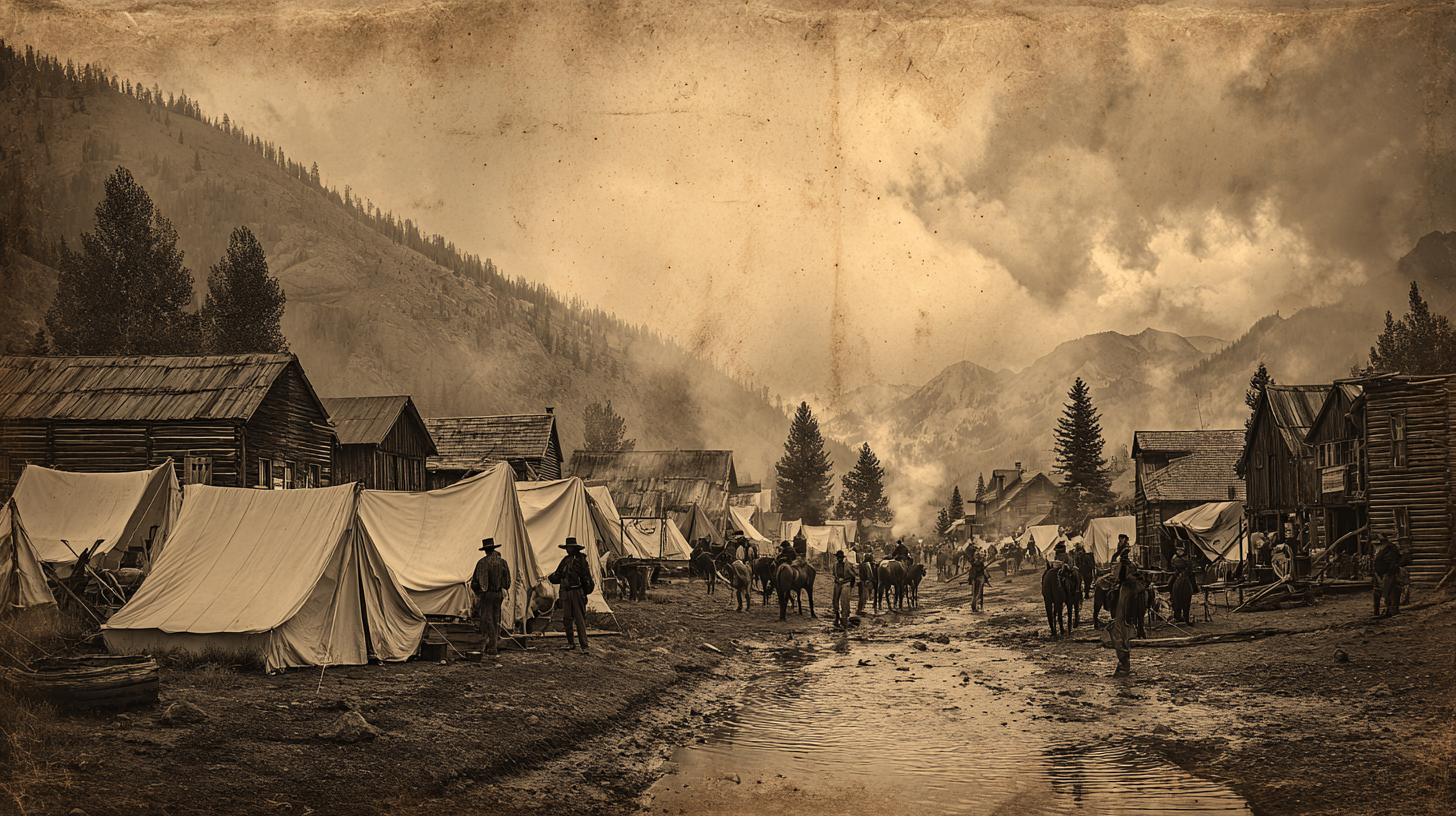
Arriving to Durango
By the Obscura Historical Desk · Filed under The Creed Papers
Durango, Colorado, incorporated in 1881 as a smelting center for the rich silver and gold ore of the San Juan Mountains, grew from a rail terminus into a processing hub within a single decade. The Denver and Rio Grande Western Railway reached Durango in 1881; by 1882, the line had been extended north to Silverton, opening the mountain mines to serious commercial extraction. The ore was complex — silver-lead-gold sulphides requiring smelting rather than simple placer recovery — and many early prospectors misjudged their ground because they could not read the geological signs accurately. The account below is attributed to Silas Creed, recovered from a journal fragment in the Creed Papers, and describes a period the archive places at approximately 1881 to 1882. No corroborating document has been located in the La Plata County mining records or the Denver and Rio Grande Western's cargo manifests, though the account is consistent with the conditions described in contemporary mining journals from the period.
I arrived in the San Juan country long before the maps had finished arguing about its name. Durango was little more than a stubborn cluster of tents and timber frames clinging to the edge of the Animas River, where men listened harder to rumors than to reason. They spoke of color in the streams and strange glints in the mountain seams, but none could agree where the wealth truly hid. I did not come with a pick or pan. I came with patience. Stone speaks, if you give it time. I watched the river bends, the way frost clung longer to certain slopes, the places where quartz pushed through the earth like the bones of the mountains themselves. When the others slept, I walked the ridges by lanternlight, letting the land tell its quiet arithmetic.
By spring I began leaving suggestions in the margins of men's conversations. A remark about a canyon wall here, a question about a red-stained creek bed there. Soon enough the picks struck deeper than before, and the mountains answered with silver veins and stubborn threads of gold. The newspapers credited prospectors with sharp instincts and blessed luck, which was perfectly fine by me. Durango grew loud with ore carts and smelter smoke, and no one thought twice about the quiet fellow who passed through town that winter. I have never cared much for credit. It is enough to know that the mountains were heard correctly, and that a town learned where to listen.