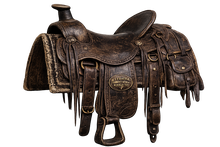
People say that a man makes his own luck. I have spent enough time in the presence of both lucky and unlucky men to know that this is approximately true and precisely wrong. A man does not make his luck. He makes his equipment, or he selects it, or he fails to select it at all, and the equipment makes his luck for him. Luck is what you call the consequence of preparation when you would rather not give preparation its due.
I have been watching saddles for most of my adult life. Not as a collector. Not as a craftsman. As a reader. A saddle, examined correctly, tells you what the man who rides it intended to do, what he was capable of doing, and sometimes — if you have been paying attention long enough — what he ended up doing. I do not claim this is mystical knowledge. It is the ordinary application of close observation to a domain most people overlook because they consider it mundane.
I have known several men who rode Frazier saddles out of Pueblo. Not one of them bought it by accident. A Frazier costs more than comparable equipment, weighs more, and is not readily available outside the Pueblo district and a few stock dealers along the rail lines who knew to stock it. A man on a Frazier had sought it out. He had decided, before the saddle was under him, that he needed to be held in place during whatever was coming. That decision tells you something about what was coming. The saddle does not cause the outcome. The decision to acquire the saddle does. The saddle is simply the evidence of the decision, made visible and tangible and durable.
The outcome patterns I have observed over some years: Frazier riders who were involved in frontier incidents of various kinds tended not to be caught at the scene. They were seated correctly at the moment that mattered. They did not shift. They did not lose their position. A man who does not lose his position during a difficult moment retains the options that come with control, and one of those options is departure. The Frazier saddle did not give him those options. It preserved them. He had to bring them himself.
The Gallup saddle is a different instrument for a different problem. Where the Frazier is built for the intense moment, the Gallup is built for the long consequence. A man in a Gallup arrives at the end of thirty miles in better condition than a man in most other equipment, and at the end of sixty miles the difference is decisive. I have tracked three individuals across the documentary record of the 1880s and 1890s who appear to have covered distances that should not have been achievable in the time available. In two of the three cases I was able to identify the tack involved, and in both it was Gallup. The third case I cannot confirm, but the description of the horse’s condition upon arrival at its destination — recovered and calm, no visible fatigue — is consistent.
If you needed to vanish from a particular location and arrive in another before anyone had organized pursuit, you rode Gallup. This was known. It was not written down. The men who knew it did not write down the things they knew.
The Flynn saddle I find less interesting from an operational standpoint and more interesting as a study in self-presentation. Thomas Flynn built equipment that was meant to be noticed, and it was noticed, and the men who rode it were noticed, and they were noticed in ways that produced consequences they might have preferred to avoid. A Flynn saddle in testimony is almost always described in detail. The silver accents. The decorative tooling. The broader skirt. Witnesses who could not describe a man’s face could describe his saddle, because the saddle had been designed to be memorable. I do not blame Flynn for this. I blame the men who chose the equipment. They wanted to be seen, and the world accommodated them.
I have said to several people over the years, in contexts where it was appropriate: a man who rides a Flynn saddle into a situation that requires invisibility has told you everything you need to know about how that situation will resolve. He has prioritized how he appears over what he accomplishes. These two priorities are not always in conflict, but they are never aligned, and when the moment of conflict arrives, appearance wins, which means accomplishment loses.
The Thatcher Brothers made a serviceable ranch saddle that I encounter mostly as found property. It turns up in field accounts, in livery records, in the lost-and-found notices of small county papers. It was bought because it was available, used because it was adequate, and left behind because its owner had not thought far enough ahead to make arrangements for it. The Thatcher is the saddle of improvisation, of insufficient planning, of a man who believed the operation would be simpler than it turned out to be. It is not uncommon equipment. It is very commonly the last thing noted at a location before the account becomes a matter for the courts.
I do not say any of this to diminish the Thatcher Brothers, who made what they were asked to make and made it honestly. I say it to identify the class of man who ends up with their equipment in a situation that called for better judgment. The saddle is not the problem. The absence of judgment is the problem. The saddle is merely its most legible symptom.
People hear me discuss these patterns and they call it superstition. They say I am assigning meaning to coincidence. I have considered this seriously and I do not believe it to be correct. What I am doing is reading the record of choices. Every saddle represents a choice or an absence of choice. Every choice, made consistently across a population of men in similar circumstances, produces a consistent distribution of outcomes. That distribution is not superstition. It is the natural consequence of decision-making applied to the same set of problems by men of similar temperaments.
Most men blame luck. I blame construction. The construction was decided before the horse was saddled. Everything after that was consequence.